
News & Insights
2026年2月1日
What is AQL and How Do You Use It? (A Simple Guide for Importers in 2026)
What is AQL? Learn how to use Acceptable Quality Limit sampling in 2026 for product inspections. Simple guide with tables, examples, tips & free checklist for importers.
If You're Importing from China, You've Probably Heard of AQL – But What Does It Really Mean?
If you're bringing products in from China, AQL can sound technical and scary. But it's actually one of the best tools to protect your business from bad quality shipments.
In short: AQL (Acceptable Quality Limit) is a statistical sampling method. It tells you how many items to randomly check in a large order, and how many defects are "acceptable" before you reject the whole batch.
It's not a guarantee of zero defects – no method is – but it's the global standard (based on ANSI/ASQ Z1.4 / ISO 2859-1) that helps you make smart, data-driven decisions. In 2026, the tables haven't changed much since the last major update, so the classic rules still work perfectly.
Think of it like this: You ordered 10,000 t-shirts. Checking every single one is impossible and expensive. AQL says: "Pull a smart sample, count the problems, and decide if the whole order is good enough."
The 3 Key Parts You Need to Understand AQL
To use AQL, focus on just three things:
1. Your Lot Size (Total Order Quantity)
This is the full number of units produced (e.g., 10,000 t-shirts).
2. Your Inspection Level
Most importers use General Inspection Level II (G-II). It's the sweet spot: thorough enough for confidence, but not too costly. (Level I for low-risk, Level III for high-risk.)
3. Your AQL Levels (Defect Tolerances)
Defects fall into three categories – you set different limits for each:
- Critical Defects (AQL 0.0 – zero tolerance): Anything that could hurt someone or break laws. Example: Sharp needle in clothing, toxic material. One = fail the batch.
- Major Defects (AQL 2.5 standard): Makes the product unusable or unsellable. Example: Broken zipper, wrong size, big stain. Most importers set 2.5 here.
- Minor Defects (AQL 4.0 standard): Small cosmetic issues most customers ignore. Example: Loose thread, tiny scratch.
These levels (0.0 / 2.5 / 4.0) are the most common for consumer goods – we've used them on thousands of inspections.
How to Use AQL Sampling Tables – Step-by-Step Process
The tables look complicated at first, but follow these 4 steps – it's straightforward once you do it once.
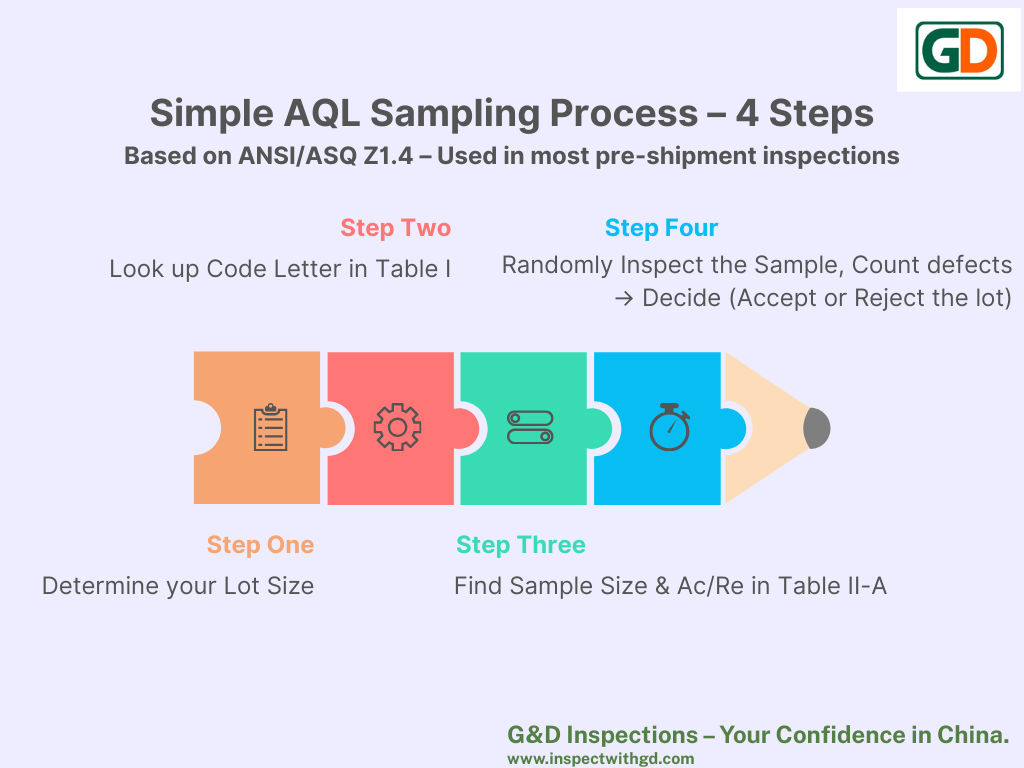
Step 1: Find Your Lot Size Range
Look up your order quantity in Table I (Sample Size Code Letters).
Step 2: Get Your Code Letter
Go across to General Inspection Level II – it gives a letter (e.g., for 10,000 units → Code L).
Step 3: Find Sample Size
In Table II-A (Single Sampling Plans), find row L → Sample size = 200 units.
Step 4: Check Accept/Reject Numbers
For your AQL levels:
- AQL 2.5 (major): Accept ≤10 defects, Reject ≥11.
- AQL 4.0 (minor): Accept ≤14 defects, Reject ≥15.
- AQL 0.0 (critical): Accept 0, Reject 1+.
ANSI/ASQ Z1.4 Table I Excerpt (Sample Size Code Letters – Common Ranges)
Lot Size (pieces) | General Inspection Level II (Most Used) |
|---|---|
501 to 1,200 | J |
1,201 to 3,200 | K |
3,201 to 10,000 | L |
10,001 to 35,000 | M |
(For full table, see official standard or calculators.)
ANSI/ASQ Z1.4 Table II-A Excerpt (For Code Letters K & L – Common for Medium Orders)
Code Letter | Sample Size | AQL 0.0 (Critical) Ac/Re | AQL 2.5 (Major) Ac/Re | AQL 4.0 (Minor) Ac/Re |
|---|---|---|---|---|
K | 125 | 0/1 | 7/8 | 10/11 |
L | 200 | 0/1 | 10/11 | 14/15 |
Example: 10,000-piece order (Code L) → Sample 200. If you find 10 or fewer major defects, accept. 11+ → reject or fix.
The Easy Way: Use an AQL Calculator (No Manual Tables Needed)
Don't want to flip through charts? Use a free online AQL calculator – enter lot size, level, and AQLs, get instant results.
[Contact Us for a Consultation]
We often use these on-site for speed.
AQL Is a Tool, Not the Whole Strategy
AQL tells you how many to check – but not what to look for. Pair it with:
- A detailed quality checklist (specific to your product).
- Professional inspectors who know your specs.
In our inspections, we always combine AQL sampling with photo reports and clear explanations – so you know exactly what to do next.
The Bottom Line
AQL takes the guesswork out of accepting shipments. It gives you data-driven confidence to pay, rework, or reject – protecting your money and reputation.
We've seen it save clients from costly disasters time and again.
Have questions about setting up AQL for your next order? Drop us a message – we'll walk you through it for free, including a custom checklist.
[Button: Get Free AQL Advice & Checklist]
[Button: Contact Us for a Consultation]
FAQ Section
What AQL levels should small importers start with?
0.0 critical, 2.5 major, 4.0 minor – balanced and standard.
Has AQL changed in 2026?
No – ANSI/ASQ Z1.4 tables are stable.
What if my batch fails AQL?
Negotiate fixes/re-inspection. We help push factories.